Underwater heritage risk framework
Understanding how environmental conditions influence the long-term persistence of submerged cultural heritage.
Developing suspended nursery systems that separate early seagrass establishment from transplantation to the seabed.
Project
Seagrass Blue
Focus
Seagrass cultivation and restoration
Species
Posidonia oceanica and Cymodocea nodosa
Approach
Suspended cultivation, modular pod systems, environmental monitoring and field testing
Role
Co-founder — ecological design, cultivation strategy, field operations,
monitoring and experimental development
Restoring seagrass is not simply a matter of putting plants back into the sea. Newly planted material must establish roots and begin growing while immediately exposed to the conditions that contributed to restoration failure in the first place. Sediment movement, burial, herbivory, poor substrate conditions and other local stresses can all act during this vulnerable early stage.
Seagrass Blue is testing a different approach: separate establishment from transplantation.
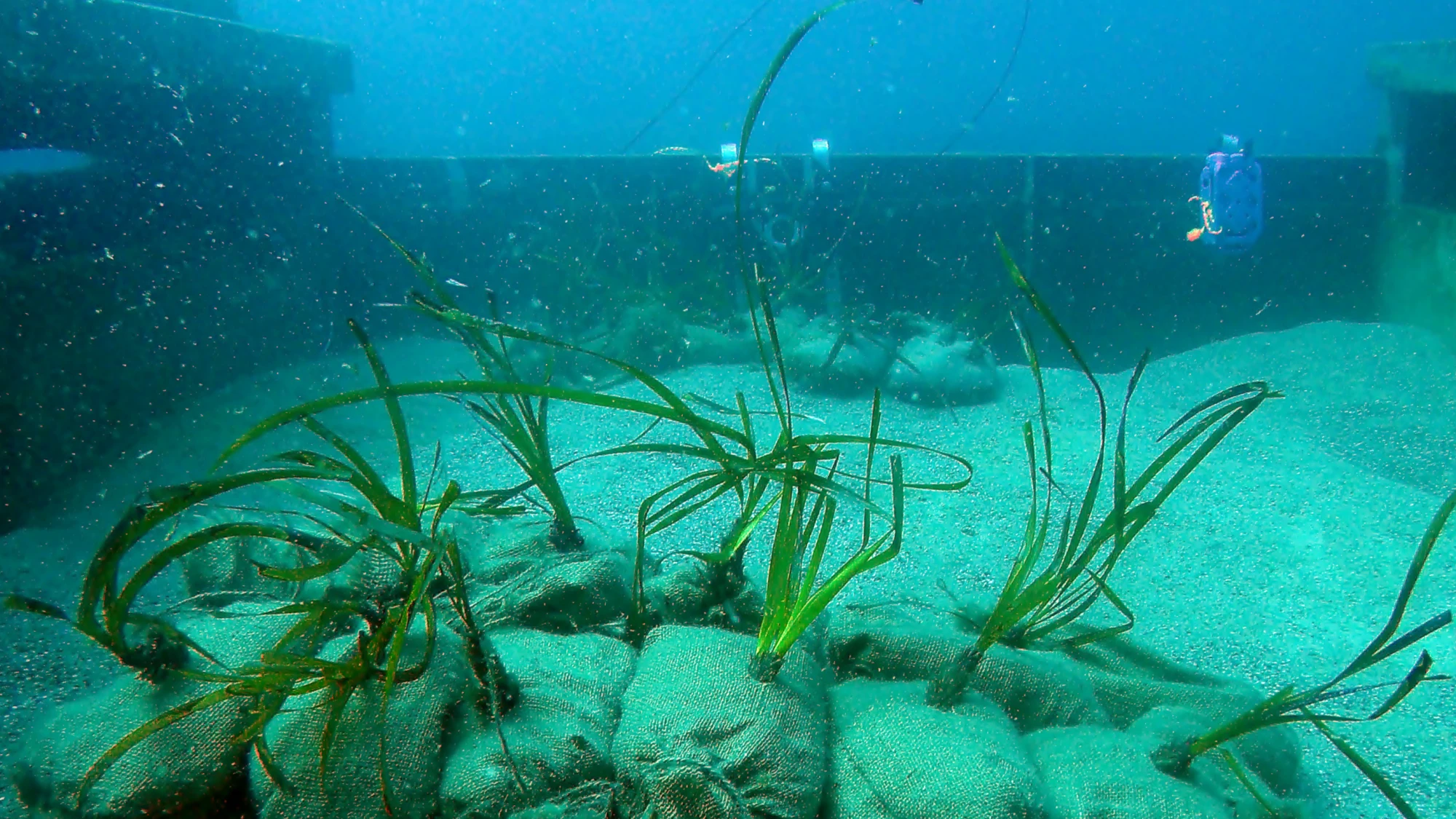
Rather than placing newly collected or propagated material directly onto the seabed, plants are cultivated first in suspended underwater nurseries. The aim is to allow root and shoot development under conditions where plants can be accessed, monitored and maintained before being transferred to their final restoration site.
Instead of asking a newly planted seagrass shoot to survive everything at once, the idea is to separate establishment from transplantation.
The principle is straightforward. Making it work at sea is not.
The cultivation system needs to hold plants at an appropriate depth while remaining stable in currents and waves. It must provide sufficient light, allow water exchange, withstand marine exposure, and remain accessible to divers. Plants need to be retained without constraining growth, while the entire system has to survive long enough for cultivation to be useful.
This has led to the development of modular pod structures combining cultivation trays with buoyancy, mooring and monitoring systems. Field deployments provide a way to test not only plant performance but the practical engineering needed to operate a suspended nursery over extended periods.
Development has included deployments at the OBSEA underwater observatory off the coast of Barcelona, where pod-based cultivation and environmental monitoring can be tested under real offshore conditions.
An important advantage of the suspended approach is accessibility.
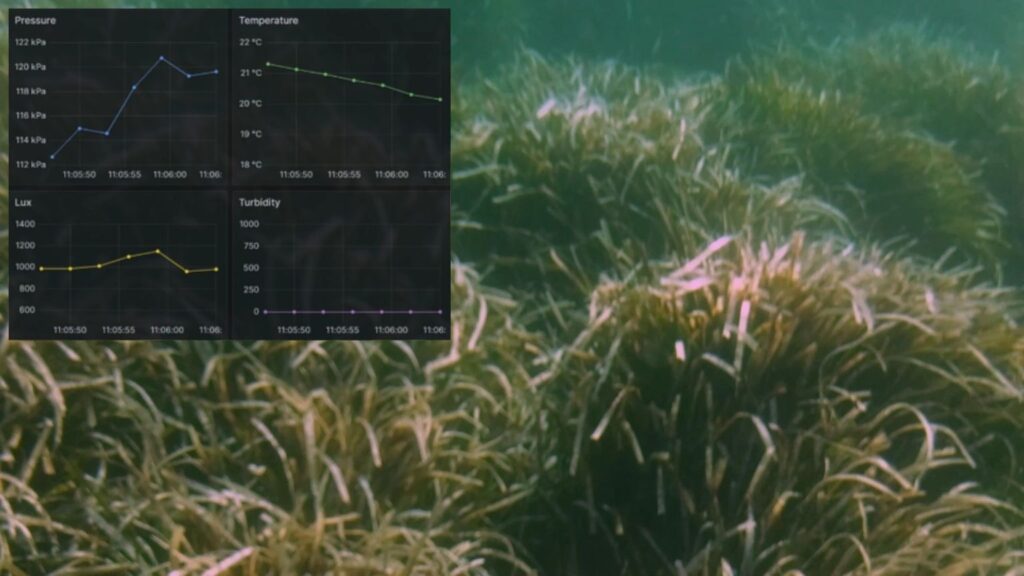
Restoration experiments on the seabed can be difficult to inspect repeatedly without disturbing them. A nursery system can instead be designed around observation: plants can be photographed, environmental conditions measured, and individual components inspected or replaced.
Monitoring has therefore developed alongside the cultivation system rather than being added afterwards. Cameras and environmental sensors provide information on plant development and local conditions over time, while field observations expose practical engineering problems that are difficult to reproduce on land.
Hydrodynamic loading, buoyancy and trim, mooring behaviour, biofouling, component failure and the practicalities of working on the structure underwater all feed back into subsequent designs.
This is active development rather than a finished restoration technology.
Ultimately, the engineering only matters if the biological premise works.
The immediate question is whether seagrass material can establish and grow successfully in suspended cultivation. But the more important restoration question comes afterwards: whether plants established in the nursery can be transferred successfully to the seabed.
Those stages need not have the same environmental requirements.
Separating them creates the possibility of treating establishment and transplantation as different ecological and operational problems, rather than expecting a single planting method to solve both simultaneously.
It also makes the nursery a platform rather than a fixed design. Different cultivation trays, planting material, depths, monitoring approaches and pod configurations can be tested without changing the underlying idea.
The first generation of pod systems moved the concept from an idea to field deployment. New pod designs are now being developed, alongside changes in buoyancy, mooring, monitoring and deployment strategy.
The continuing work is not simply about making the structures larger. It is about understanding where suspended cultivation provides an advantage, how the nursery should be engineered for different environments, and whether established plants can ultimately be transferred into persistent seagrass habitat.
Other projects linking environmental science, field experimentation and practical decision-making.
Understanding how environmental conditions influence the long-term persistence of submerged cultural heritage.
Using controlled fishing experiments, sensors and seabed mapping to distinguish anthropogenic disturbance from natural environmental change.