RESONANCE
Controlled commercial fishing experiments combining gear-contact measurement, seabed mapping and sediment analysis to quantify trawling disturbance.
Integrating environmental forcing, archaeological condition and mechanical-state modelling to explore how shipwrecks may deteriorate through time — and where monitoring may matter most.
Project
ENDURE
Focus
Underwater cultural heritage, deterioration and monitoring
Scale
North Sea, Danish Straits and Baltic Sea
Approach
Environmental modelling, archaeological calibration, mechanistic state modelling,
spatial analysis and interactive decision support
Role
Model development, analysis, software, visualisation and decision-support development
Shipwrecks persist within very different marine environments. Temperature, oxygen, salinity, currents, waves, sediment dynamics and biological activity all influence deterioration, while the importance of individual processes depends on wreck material and condition.
At the same time, the number of known and potential underwater heritage sites is far greater than the capacity for repeated survey or intervention. The practical problem is therefore not simply to describe the environment around individual wrecks, but to identify where deterioration pressure may be greatest, why sites differ, and where closer monitoring may be most useful.
One element of the ENDURE project is to develop a modelling and decision-support framework that connects regional environmental conditions with deterioration trajectories, archaeological state and possible future structural change.
The objective is not to predict the date on which a wreck will fail, but to identify why deterioration risk differs between sites and what those differences imply for monitoring.
The first component asks how strongly the surrounding environment is likely to drive deterioration. Regional marine datasets are translated into three broad pathways: physical and chemical deterioration, biological deterioration, and teredinid wood-borer activity.
Hydrodynamic exposure, temperature, oxygen availability, salinity, burial potential and biological conditions therefore contribute differently across the model domain. Material is treated explicitly: steel, wooden and mixed-material wrecks can follow different trajectories under the same environmental setting.
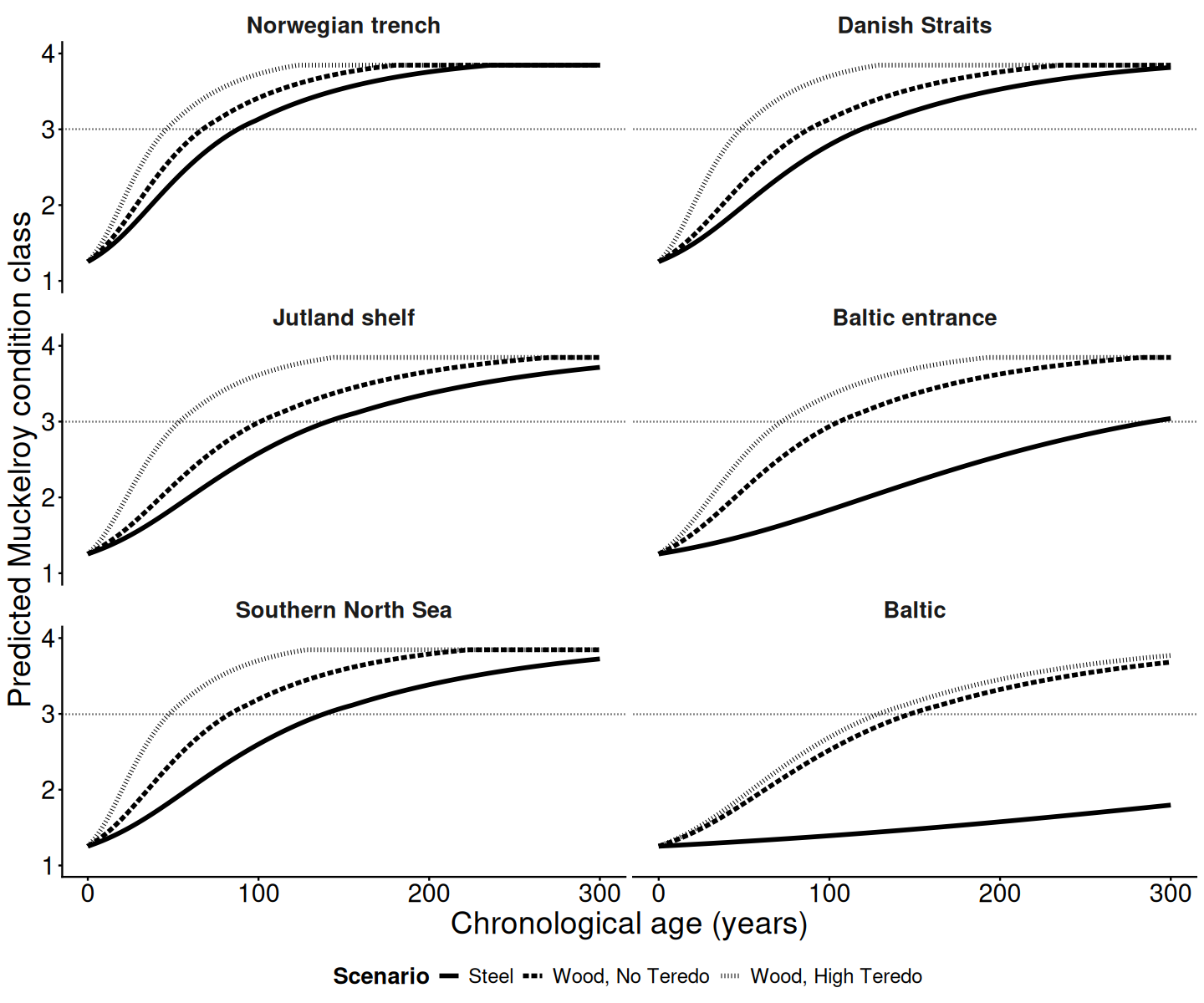
Environmental deterioration pressure is accumulated through time and linked to an empirical chronology derived from dated wrecks classified using a modified Muckelroy condition scheme. This converts relative environmental forcing into comparative deterioration trajectories and time-to-condition thresholds without treating them as predictions of exact material loss or structural lifespan.
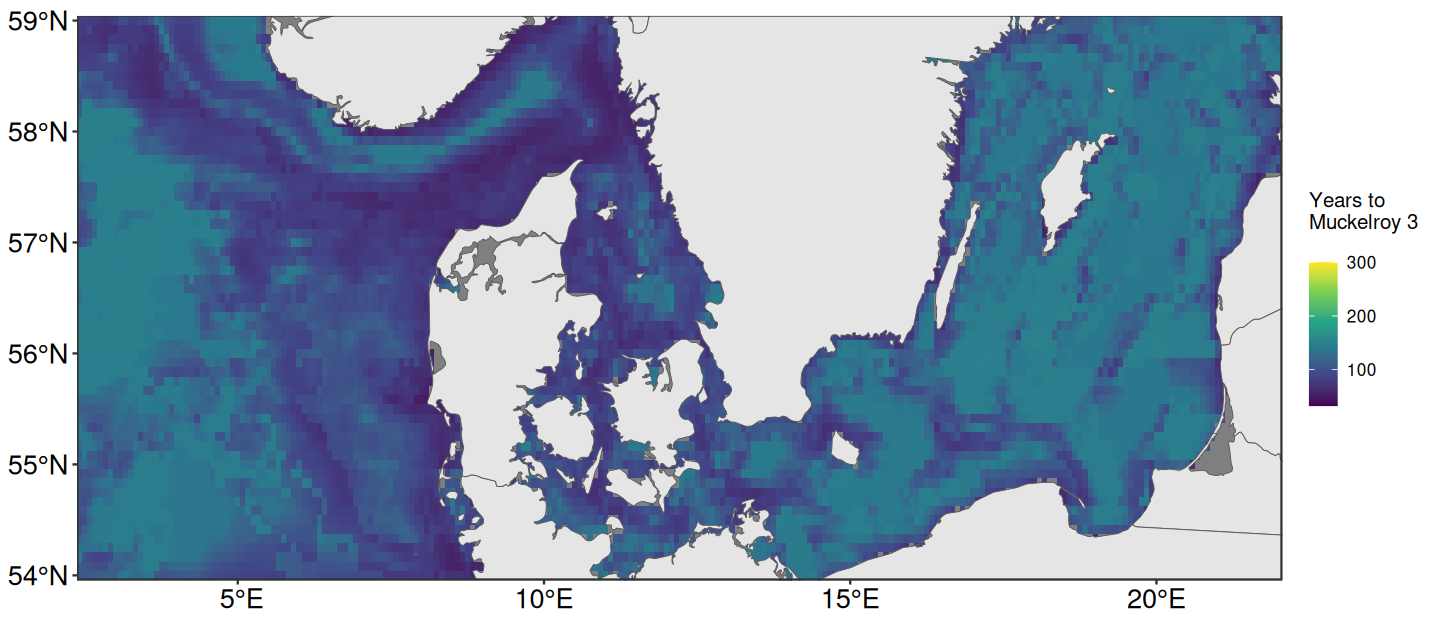
The resulting preservation landscape shows strong regional and material-dependent contrasts. Parts of the Baltic provide comparatively protective conditions, while exposed North Sea environments tend to produce more rapid deterioration. For wooden and mixed-material wrecks, the strong environmental control on teredinid activity introduces an additional regional contrast.
Environmental forcing is only one part of the problem. It describes the pressure acting on a wreck, but not the structural response of a particular wreck in its present condition.
A complementary Mechanical State Model is being developed to explore that next step. Rather than assigning a single predicted failure date, the model represents progressive weakening, thresholds and stochastic damage events that can move an ensemble of simulated wrecks between structural states.
This changes the interpretation from a deterministic trajectory to a set of possible futures. At a particular location, simulated wrecks may remain predominantly within a preservation state, progressively enter a transition domain, or show increasing probability of major structural collapse and dispersal.
Two outputs are particularly useful for interpretation: state occupancy through time and cumulative probabilities of crossing important structural thresholds. These allow questions such as the probability of major collapse within a specified period to be explored without pretending that the exact future state of an individual wreck is known.
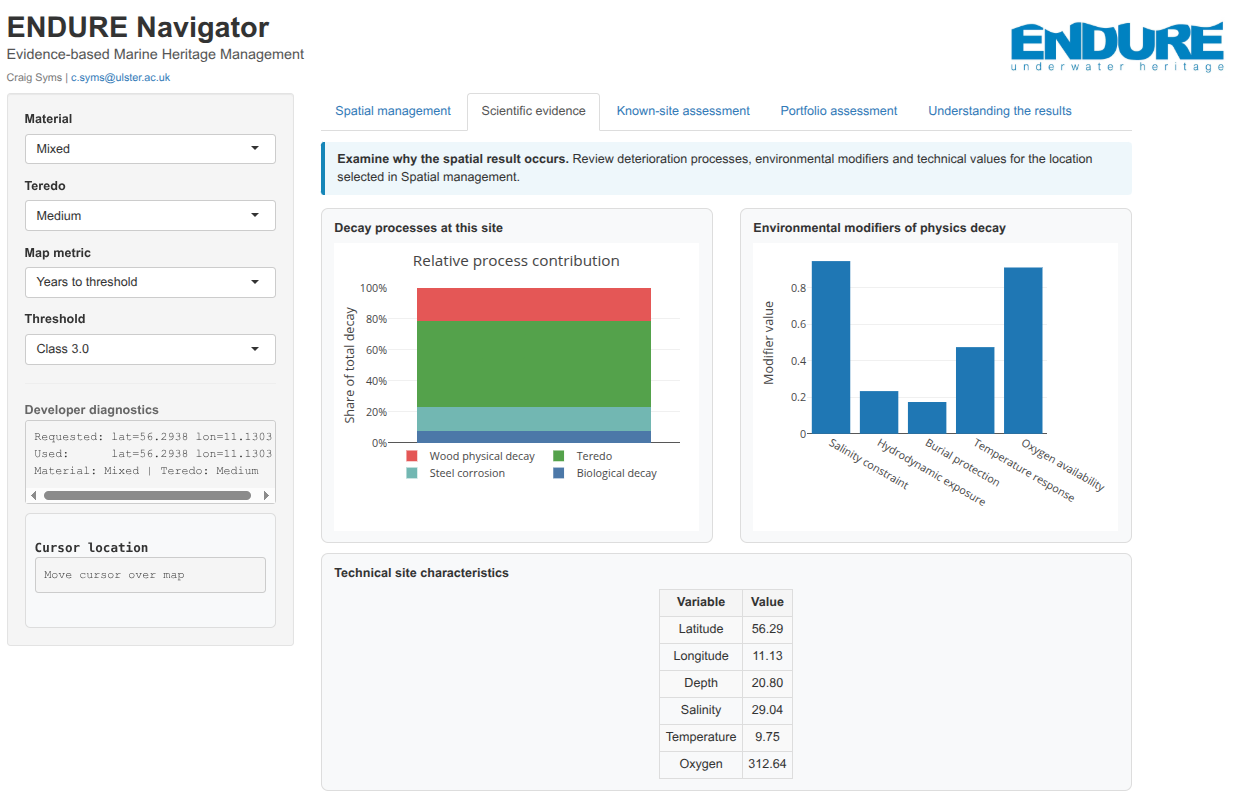
The environmental and mechanical models are being brought together within an interactive Navigator rather than left as separate analytical outputs.
The dashboard allows users to explore regional preservation patterns, inspect individual locations, compare material scenarios and deterioration trajectories, and examine the environmental processes contributing to predicted change. The intention is to retain the underlying complexity while presenting the outputs in a form that can support exploration and monitoring decisions.
This separation between model and interface is deliberate. Environmental simulations can be computed and inspected independently, while the dashboard provides a practical layer for comparing sites and understanding why their predicted trajectories differ.
The environmental deterioration framework has been developed and submitted for publication. It provides a spatially explicit method for translating regional marine environmental conditions into comparative deterioration trajectories for steel, wooden and mixed-material wrecks.
Development is continuing through the Mechanical State Model and the Navigator. Together, these extend the original environmental question — where is deterioration pressure greatest? — towards a broader management question: given what is acting on a wreck and what state it is in, what kinds of change are plausible and where would additional observation be most informative?
The value of the framework lies less in producing a single risk score than in making the chain from environmental evidence to deterioration, structural response and management interpretation explicit.
Other projects combining environmental evidence, field observation and practical problem-solving.
Controlled commercial fishing experiments combining gear-contact measurement, seabed mapping and sediment analysis to quantify trawling disturbance.
Developing suspended nursery systems that separate early seagrass establishment from transplantation to the seabed.